Are High Quality Grip Socks Worth It? An Honest Review

Last Updated: October 26, 2026
Quick Summary
High quality grip socks are worth it if you train on a Reformer, barre or barefoot gym floor, because full-sole silicone stops the foot sliding on the carriage or floor. They only earn their price when the pair fits properly and holds its silicone through repeated washing, so buy on fit and durability rather than price alone.
- Grip socks work purely through friction: a silicone sole pattern grips the surface instead of sliding across it.
- A 2022 PubMed study found grip socks reduced in-shoe foot movement and improved change-of-direction performance in team-sport players.
- No credible study shows grip socks reduce injury risk in any sport, so treat performance claims with care.
- Wash grip socks inside out at 30°C or lower, skip fabric softener and never tumble dry them.
- At £8.99 for a pair lasting 200 sessions, you pay about 4.5p per session.
Table of Contents
- The Verdict: When High Quality Grip Socks Earn Their Price
- How Grip Socks Work and What the Evidence Actually Shows
- The Real Benefits: Traction, Stability and Blister Prevention
- Grip Socks Fit: Why Sizing and Footwear Compatibility Decide Everything
- The Best Grip Socks for Reformer Pilates: A Comparison
- Grip Socks Durability: What Separates a Season from 200 Sessions
- How to Wash Grip Socks Without Destroying the Silicone
- The Cost-Per-Use Maths: Price, Value and What You Actually Pay For
- Choosing Your Pair: Sizing and Style at Reforman
- Frequently Asked Questions
The Verdict: When High Quality Grip Socks Earn Their Price
Are high quality grip socks worth it? For anyone training on a Reformer, yes, with one condition: the pair has to fit properly and hold its silicone through repeated washing. A grip sock is a silicone-patterned sock designed to stop the foot sliding on a carriage, mat or studio floor. Cheap pairs often fail on both counts. At Reforman, our range features full-sole grip and a fit that runs from EU 38 to EU 46, because the sock only works when the sole stays in contact with the surface beneath it.
The honest answer is that grip socks are not magic. They are a friction tool. Where friction matters, they earn their keep; where it does not, they are an unnecessary expense. Below, we break down the evidence, the fit variables, the care routine and the cost-per-use maths, so you can decide with numbers rather than marketing.
| If this is you | Verdict | Why |
|---|---|---|
| Reformer Pilates, barre or barefoot gym work | Worth it | Silicone grip stops the foot sliding on the carriage or floor |
| Socks bunching at the toes or heel | Worth it, if sized correctly | Full-sole grip plus correct sizing removes migration |
| Always training in shoes on high-traction floors | Skip | No slipping problem to solve |
| Buying on price alone | Skip | Thin, poorly bonded silicone fails within weeks |
How Grip Socks Work and What the Evidence Actually Shows
Grip socks work by putting a silicone pattern on the sole so the foot grips the surface instead of sliding across it. That is the whole mechanism. No compression, no arch support, no performance enhancement beyond friction.
The independent evidence is thinner than the marketing suggests. A 2022 study indexed on PubMed, "Grip socks improve slalom course performance and reduce in-shoe foot motion" found that grip socks reduced in-shoe foot movement and improved change-of-direction performance in team-sport players. Note what that study did and did not measure: it looked at feet moving inside footwear during sport, not barefoot Reformer work. The result does not state the size of either effect.
That distinction matters. Most of what you read about grip socks conflates two different claims: that they reduce slipping (well supported by mechanism and common experience) and that they improve athletic performance or prevent injury (far less established). A controlled study on a slalom course is not the same as a controlled study on a Reformer carriage, and neither tells you whether a sock will stop a blister on a long run.
So treat performance claims with care. What grip socks reliably do is reduce slipping. Whether that translates into better balance or faster changes of direction depends on the activity. On a Reformer carriage, where the foot is pressing against a moving platform, reduced slipping is the entire point. In a gym, the benefit is smaller but real: a foot that stays put inside a shoe reduces the micro-adjustments that sap control during loaded movements.
Where the evidence is weakest is injury prevention. No credible study shows that grip socks reduce injury risk in any sport. The blister-prevention claim is more defensible because it follows directly from friction reduction, but it is still a mechanism argument rather than a trial result. If you are buying grip socks to solve a slipping problem, the evidence supports you. If you are buying them expecting a performance edge, the honest answer is that the effect, if any, is small and activity-dependent.
What the evidence does support is a simple decision rule: if your foot slides on the surface you train on, a well-made grip sock will help. If it does not, the sock has nothing to do. That is the standard we build to, full-sole grip that stays in contact with the surface, so the mechanism has the best chance of working as intended.
The Real Benefits: Traction, Stability and Blister Prevention
The measurable benefits of grip socks are traction, stability and less friction inside footwear. Blister prevention follows from that same friction reduction, not from anything in the fabric itself.
Here is how each benefit actually shows up in practice:
- Traction: the silicone sole grips the carriage, mat or floor so footwork stays controlled through slow, loaded movements.
- Stability: a foot that is not sliding gives you a fixed base for balance work, which matters more on a moving carriage than on a static mat.
- Blister prevention: friction between foot and shoe is a common cause of blisters, and a sock that stays put reduces that rubbing.
- Comfort underfoot: cushioning and moisture management matter here. A breathable cotton, nylon and spandex blend keeps the foot drier than a thin synthetic pair.
What most guides miss is that these benefits are conditional. A sock that bunches at the heel removes the grip from where you need it and creates a new pressure point. Traction only counts if the silicone stays under the parts of the foot doing the work.
Grip Socks Fit: Why Sizing and Footwear Compatibility Decide Everything
Fit decides whether grip socks work. If you are unsure which size to pick, read the guide to choosing Pilates socks size before you buy. A pair that is too loose will migrate, bunch and roll at the heel, pulling the silicone away from the sole. If bunching at the toes is already a problem, these fixes for grip socks bunching at toes cover the practical adjustments. A pair that is too tight restricts the toes and wears through faster at the seams.
Wider feet are the common failure case. Many "one size fits all" grip socks are cut narrow, so anyone with a broader foot ends up with fabric bunched at the toes and grip sitting off-centre. Our engineered stretch is designed to cover EU 38 to EU 46 across the range.
Footwear compatibility matters too, and it is where most guides stop short. Grip socks are built for barefoot training, so pairing them with shoes defeats the purpose. But the interaction between sock thickness and shoe fit is worth understanding even if you only wear them in the studio. A thicker sock changes how a shoe fits: it can take up volume in the toe box, press the instep against the laces, and alter where pressure sits under the arch. If you wear grip socks inside a gym shoe for a class that moves between mat and equipment, choose a thin pair so the shoe still fits as it did when you bought it.
Foot shape matters as much as size. A high instep needs a sock that does not pull tight across the top of the foot; a narrow heel needs a sock that hugs without gaping. Where a sock has a defined heel pocket, it stays put better than a tube construction. If you wear orthotics or a custom insole, a grip sock adds a layer between foot and insole, usually fine, but worth testing before a long session rather than during one.
Where grip socks shine is the studio floor, the Reformer carriage, the mat and the gym floor. Worn around the house with sandals or bare floors, they simply add a layer of grip and comfort. The one combination to avoid is a loose sock inside a loose shoe: the sock migrates, the grip pattern ends up under the arch instead of the ball of the foot, and you get the worst of both.
Get the fit right and the grip does its job. Get it wrong and no amount of silicone will save the session.
The Best Grip Socks for Reformer Pilates: A Comparison
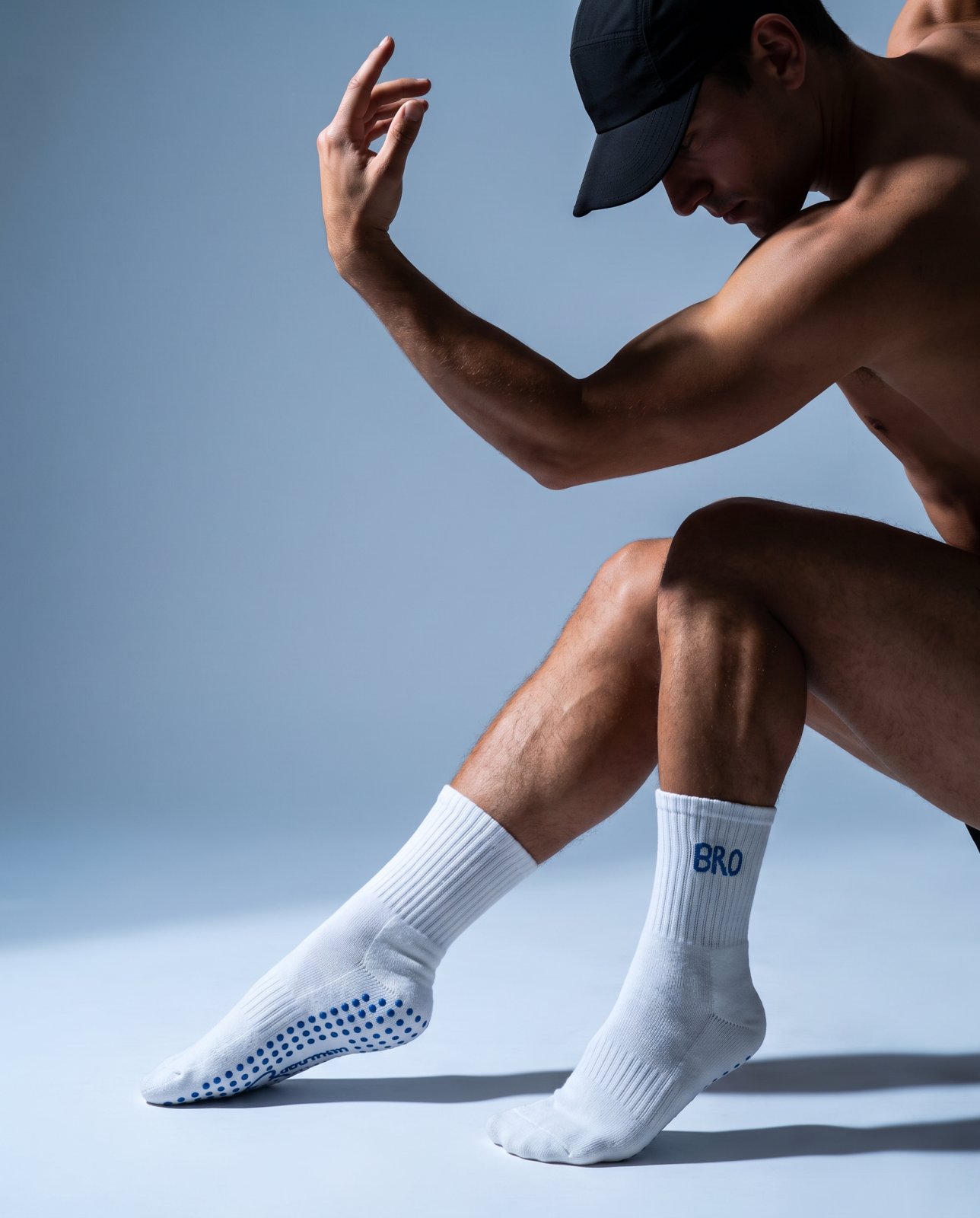
The best grip socks for Reformer Pilates combine a full-sole silicone pattern, a secure fit and a fabric blend that survives frequent washing. Our range is built to that brief, and each pair sits at a similar price with small differences in cut and design.
| Style | Price | Grip | Sizing | Best For |
|---|---|---|---|---|
| Classic Grip Socks | £8.99 | Full-foot dotted silicone | EU 39-44 | Stripped-back everyday training |
| Ankle Grip Socks | £7.99 | Full sole, ball to heel | EU 38-46 | Wider size range, lower cut |
| Wave Grip Socks | £8.99 | Full-sole silicone | EU 39-44 | Studio-to-street wear |
| Palms Grip Socks | £8.99 | Full-sole silicone | EU 39-44 | Clean print, multi-use |
| Foothills Grip Socks | £8.99 | Full-foot silicone | EU 39-44 | Earthy graphic, high traction |
The Classic is the one we would point most people to first. It has no pattern competing with the job, the dotted sole covers the full foot, and the gender-neutral colourway pairs with anything. The Ankle cut is the pick for anyone at the top or bottom of the size range, since it spans EU 38 to EU 46.
Watch out: buying a patterned pair for the look and ignoring the sole coverage. A partial grip pattern leaves the arch and heel unanchored, which is exactly where migration starts.
Classic Pilates Grip Socks | Non-Slip, Stable | Reforman →
Grip Socks Durability: What Separates a Season from 200 Sessions
Durability in grip socks comes down to three things: how well the silicone is bonded to the fabric, how the seams are finished, and how the sock is washed. Bonding is the big one. Silicone that is printed thinly or cured poorly starts flaking at the edges, and once one dot lifts, the rest follow.
We build our socks to withstand 200+ sessions, and the customer feedback we get points to the same thing. As one customer put it, "Goes perfectly with all my workout gear and super durable too." That is the standard we aim for: a sock that holds its shape and its grip rather than one that looks good for a month.
Signs a pair is nearing the end of its life:
- Silicone dots lifting at the edges or peeling away
- Grip pattern worn smooth in the ball or heel zone
- Elastic losing recovery, so the sock slides down mid-session
- Thinning fabric at the heel or toe
The difference between a season and 200 sessions is usually care, not luck. Which brings us to washing.
How to Wash Grip Socks Without Destroying the Silicone
Wash grip socks inside out on a cool cycle and skip the tumble dryer. Heat is what kills silicone grip, and the dryer is the fastest way to turn a grippy sole into a smooth one.
A routine that protects the grip:
- Turn the socks inside out before washing
- Use a cool or cold machine cycle, 30°C or lower
- Skip fabric softener, which coats the silicone
- Air dry flat or hang, never tumble
- Keep them out of direct heat sources like radiators
Most grip loss we hear about traces back to a hot wash or a tumble dry. If your socks have started slipping after washing, this guide to stopping socks slipping explains how to restore the hold. The silicone itself is durable; the bond between silicone and fabric is what heat attacks. Treat the pair gently and the grip pattern lasts far longer.
The Cost-Per-Use Maths: Price, Value and What You Actually Pay For
Cost per use, not sticker price, is the number that matters. A £7.99 pair worn twice a week for a year costs roughly 8p per session. A £4 pair that loses its grip in two months and gets replaced four times a year costs more in total and delivers worse grip throughout.
Run the maths on your own training:
Cost per use = price ÷ (sessions per week × weeks worn)
At £8.99 for a pair that lasts 200 sessions, you are paying about 4.5p per session. That is the value case for buying quality. The contrarian point is that not everyone needs it. If you train once a month, a cheaper pair may genuinely be the rational buy. If you are on the Reformer three times a week, the maths flips hard toward durability.
Where the money goes in a quality pair: full-sole silicone coverage, a fabric blend that holds shape, and construction that survives washing. That is what you are paying for, not a logo.
Choosing Your Pair: Sizing and Style at Reforman
Choosing the right pair comes down to three questions: what surface you train on, what size you take, and whether you want the sock to work outside the studio. Answer those and the decision is straightforward.
Our approach is simple. Gender-neutral design, full-sole grip, and a fit that covers a genuine size range rather than a nominal one. One customer noted, "Love these. I wear them for not only Pilates but when I'm wearing my Birkenstocks too," which is the multi-setting use we design for. Another said, "Love my socks so much. They are fantastic for leg day at the gym, I like to go barefoot." That is the studio-to-street idea in practice.
If you are ready to choose, you can shop the grip socks collection and see the full range in one place. Start with the Classic if you want the most versatile pair, or the Ankle if you sit at either end of the size range.
Frequently Asked Questions
Do grip socks actually make a difference?
They can, but the evidence is narrower than marketing suggests. A 2022 study on team-sport players found grip socks reduced in-shoe foot motion and improved change-of-direction performance, though the size of either effect was not stated. That study did not test Pilates or Reformer use. In practice, the difference you feel comes from a full silicone sole holding against the carriage or mat, which stops the foot migrating and bunching. Whether that matters to you depends on how much you slip in regular socks.
How long do grip socks last?
Grip socks durability depends on the silicone coverage, the fabric blend and how you wash them. A pair with full-sole grip and a cotton, nylon and spandex blend holds its shape and grip far longer than thin novelty pairs, which is where most complaints about poor grip after two months come from. Reforman builds its socks to withstand 200+ sessions. Washing them inside out on a cool cycle and skipping the tumble dryer is the single biggest factor in keeping the silicone intact.
Can you wear grip socks outside Pilates?
Yes. The grip socks fit and clean, gender-neutral designs work well beyond the Reformer. Reforman's range is built for barre, yoga, the gym and everyday wear, and customers report wearing them with sandals and around the house. The full-sole silicone gives traction on studio floors and gym surfaces alike. If you want one pair that moves from a reformer class to leg day to home, choose a neutral colourway rather than a loud print.
How do you wash grip socks without damaging the grips?
Turn them inside out, wash on a cool cycle at 30°C or below, and skip fabric softener, which coats the silicone. Never tumble dry grip socks, because heat degrades the grip pattern faster than anything else. Air dry them flat. Wash them after every few sessions rather than every single one to extend fabric life, and keep them out of a hot wash with heavy items that abrade the sole.
Are high-quality grip socks worth it for Pilates?
For regular Reformer practice, yes. At £8.99 for a Classic pair, the cost per session drops quickly: over 200 sessions that is under 5p a wear. The value comes from grip that lasts, a fit that does not bunch at the toes, and a gender-neutral design you will actually wear outside the studio. Cheap pairs that lose grip in two months cost more per use. The main caveat is fit: check the EU size range before ordering.
The real test of a grip sock is not the first session but the fiftieth, when a cheap pair has lost its silicone and a well-made one still holds. That is the standard we build to at Reforman: full-sole silicone grip, gender-neutral design, and engineered stretch that fits feet from EU 38 to EU 46. Get started with Reforman and train on a surface that stays under your feet, session after session.
