How to Choose Pilates Grip Socks: A Complete Guide

Table of Contents
- Why Grip Socks Change Your Pilates Session
- Pilates Grip Sock Materials: What to Look For
- How Should Pilates Socks Fit?
- Grip Placement and Sole Coverage
- How to Wash Grip Socks So They Last
- Sock Hygiene: Why It Matters More Than You Think
- Matching Grip Socks to Your Practice and Wardrobe
- Conclusion
- Frequently Asked Questions
Last Updated: October 21, 2026
Why Grip Socks Change Your Pilates Session
Grip socks are the one piece of kit that changes how every other exercise feels. Knowing how to choose pilates grip socks comes down to four things: material, fit, grip coverage and how well they wash. Get those right and the Reformer stops feeling like a surface you're sliding across. At Reforman, we design gender-neutral grip socks around exactly those four points, because a sock that migrates, bunches or rolls at the heel prevents stability.

The principle is simple. Silicone on the sole creates friction against the carriage, the mat or the studio floor. Your foot stays where you put it, so you can push through the heel without bracing your toes. That's the whole point.
Below, we break down each decision in order, from the fabric against your skin to the wash cycle that keeps the silicone alive.
Pilates Grip Sock Materials: What to Look For
Most decent grip socks use a cotton, nylon and spandex blend. Cotton gives breathability and a soft feel against the skin. Nylon adds strength and helps the sock hold its shape. Spandex provides the stretch that keeps the sock close without pinching.

Pure cotton feels lovely and loses its shape fast. All-synthetic socks grip well but can turn clammy during a long session. The blend is the compromise that works.
What most guides miss is the sole. Look for silicone rather than printed rubber or a sprayed coating. Silicone stays tacky through repeated washing. Cheap printed grips go smooth within weeks, which is the single most common reason people replace grip socks.
Check the stretch before you buy. A sock that only stretches one way will pull across the toes. Engineered stretch, where the knit flexes in both directions, is what stops the bunching that wide-footed wearers know too well.
How Should Pilates Socks Fit?
Pilates socks should fit snugly across the arch and heel with no fabric pooling under the toes and no tightness across the top of the foot. The heel cup should sit on your actual heel, not halfway up your ankle. If you can pinch more than a centimetre of spare fabric at the toe, the sock is too big.
Fit is where most grip socks fail. "One size fits all" is a marketing phrase, not a measurement. A sock sized for a narrow foot will bunch on a wider one, and a sock stretched to its limit will pull the grip pattern out of position.
Our ankle-cut grip socks fit EU 38-46, and the Classic, Wave and Palms styles fit EU 39-44. Measure your foot length at the end of the day, when feet are at their largest, and match it to the size range rather than guessing.
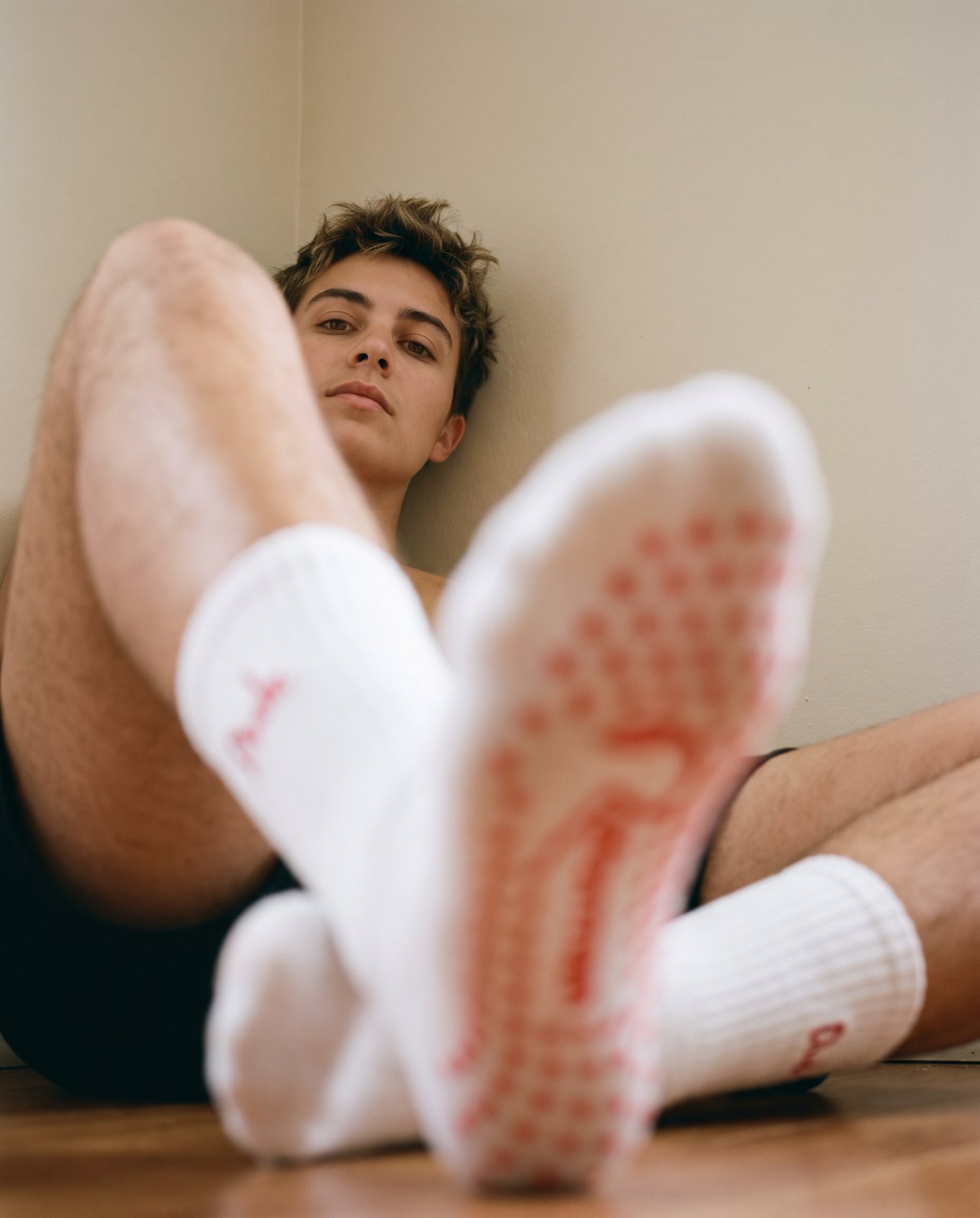
A quick check when they arrive: stand up, press your heel down and curl your toes. If the fabric stays flat and the heel cup stays put, the fit is right. If it slides, size up or down before you wash them.
Grip Placement and Sole Coverage
Full-sole grip beats a small heel-and-ball patch. Pilates footwork loads the whole foot at different angles: heels on the bar, toes on the edge, arches pressing down. A dotted full sole keeps traction through all of it.
Look at where the silicone actually sits:
- Ball of the foot for push-off and standing work
- Heel for control during slow returns
- Arch for stability in single-leg work
- Toe edge for the small adjustments that happen mid-movement
A sock with grip only under the ball will slip the moment you shift weight back. Coverage matters more than the pattern itself.
Density is the other factor. Densely dotted silicone holds better than large flat panels, which can peel at the edges. Turn the sock inside out and check that the grip is bonded into the fabric, not sitting on top of it.
How to Wash Grip Socks So They Last
Wash grip socks inside out on a cool cycle, skip the fabric softener, and air dry them. Heat and softener are what kill silicone grip. A hot wash or a tumble dryer softens the dots until they stop gripping, and fabric softener leaves a film that does the same thing.

A wash routine that works:
Ankle Pilates Grip Socks | Non-Slip, Full Sole | Reforman →
- Turn the socks inside out so the silicone faces outward and gets cleaned directly.
- Use a cool or cold machine wash with a mild detergent.
- Skip fabric softener entirely, including in the drum.
- Air dry flat or hang, away from direct heat.
- Keep them out of the tumble dryer, every time.
Rotate two or three pairs if you train often. Alternating pairs gives each one time to dry fully, which protects the stretch and the grip. It's also how you get the most sessions out of a single pair.
Sock Hygiene: Why It Matters More Than You Think
Grip socks sit against bare skin, in a studio, on shared equipment. That makes hygiene a practical matter, not a fussy one. Reformer carriages and mats are touched by many feet in a day, and a clean sock is your barrier.
Wash after every session. Not every other session. Bacteria feed on sweat and dead skin, and a sock left damp in a gym bag is the ideal environment for both. That leads to odour, skin irritation and, in some cases, fungal issues.
Have a dedicated pair for studio use and a separate pair for home or everyday wear. It keeps studio bacteria out of your casual rotation and keeps your studio socks in better condition.
Store them dry. A mesh bag or a ventilated pocket in your kit bag lets them air out between sessions. Damp socks in a sealed bag is the fastest way to shorten their life and your comfort.
Matching Grip Socks to Your Practice and Wardrobe
Match the sock to how you train. Reformer classes with lots of footwork want full-sole grip and a snug heel. Barre and mat work suit the same. Gym sessions and everyday wear want a sock that looks clean enough to be seen outside the studio.
That's where gender-neutral design earns its place. A sock with no gendered colourway and no fussy print works with everything you already own. It also means one product range serves a whole household, which is a practical benefit, not a slogan.
Our range covers the ground:
| Style | Price | Best For | Grip |
|---|---|---|---|
| Ankle Pilates Grip Socks | £7.99 | Reformer, barre, gym, everyday wear | Full-foot silicone |
| Classic Pilates Grip Socks | £8.99 | Studio sessions, minimal look | Full-sole dotted |
| Wave Pilates Grip Socks | £8.99 | Studio and street, print | Full-sole silicone |
| Palms Pilates Grip Socks | £8.99 | Studio and street, print | Full-sole silicone |
All four are built on a premium cotton, nylon and spandex blend, with a minimal logo and a clean line. The Ankle style fits EU 38-46. The Classic, Wave and Palms fit EU 39-44.
If you want one pair that does everything, start with the Classic. If you want a print that reads as design rather than novelty, the Wave and Palms are the ones to look at.
Conclusion
The right grip sock is the one that stays put through a full class and still grips after many washes. Check the material blend, get the fit right, confirm full-sole coverage, and wash them cool and inside out. That's the whole method.
If you'd rather skip the trial and error, our gender-neutral pilates grip socks are built on exactly those four points: full-sole silicone grip, engineered stretch, a clean design and a blend that holds its shape. See the range and pick the pair that matches how you train.
Frequently Asked Questions
Do you need grip socks for Pilates?
Most Reformer studios require them, and for good reason. Grip socks stop your feet sliding on the carriage, which matters for footwork, lunges and standing poses. On a mat, they reduce slipping on smooth floors and add a layer of hygiene between your feet and shared equipment. If you train at a studio that provides equipment for everyone, grip socks are usually a condition of entry rather than an optional extra.
Should Pilates grip socks fit tightly?
They should fit closely, not tightly. A good pair sits smooth against the skin with no slack at the heel and no pressure across the toes. If the heel rolls or the fabric bunches under the arch, the sock is too big, and that slack is exactly what causes migration mid-session. Check the size range before ordering: Reforman's Classic, Wave and Palms socks fit EU 39-44, and the Ankle sock fits EU 38-46.
How do you wash Pilates grip socks?
Turn them inside out, wash at 30°C or lower on a gentle cycle, and skip fabric softener, which coats the silicone and dulls the grip. Air dry rather than tumble drying, because heat degrades both the stretch fibres and the grip pattern. If you wash after every session, a second pair keeps you training while the first dries. Hand washing works too and extends the life of the silicone dots.
How often should you replace Pilates grip socks?
Replace them when the silicone starts to smooth over, the heel elastic loosens, or the fabric thins at the ball of the foot. With regular washing and air drying, a well-made pair should hold its grip for a long run of sessions. Rotating two or three pairs spreads the wear and keeps the grip pattern intact for longer. If you notice slipping on the carriage that wasn't there before, the sole is telling you it's time.